Illustration, AI-generated from the story text. Tap a panel to read the story through it.
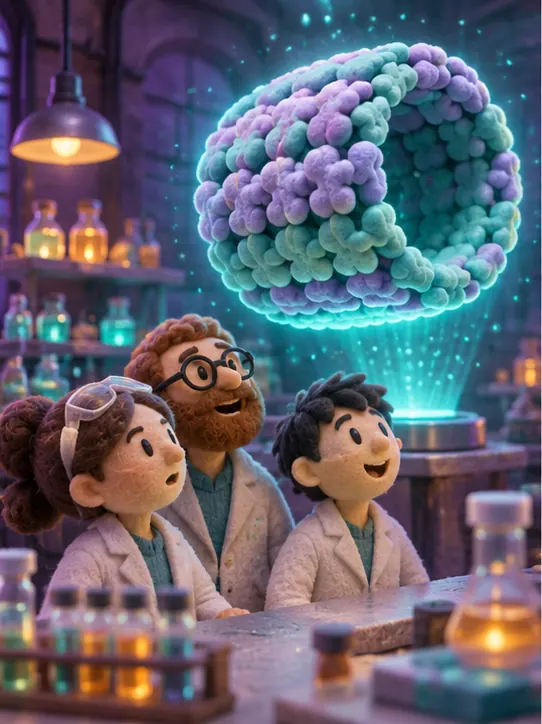
Anthropic's biology team reported the first 3D structure of a vault particle from a prokaryote, a hollow protein shell whose purpose nobody knows. It comes from a protein called L05, expressed in E. coli: 96 copies of one protein, about 9.5 megadaltons, enclosing about 25% more volume than the mammalian vault.
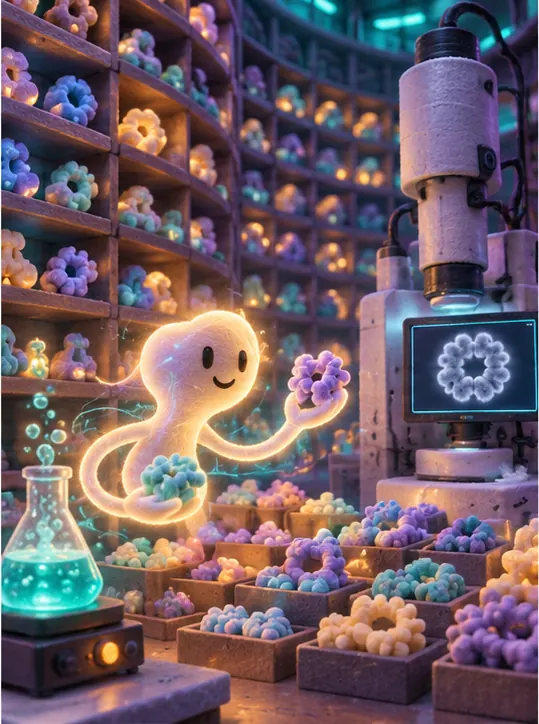
Claude searched about 15 billion predicted proteins for relatives, designed the DNA, proposed a purification shortcut that cut about three days to about 90 minutes, and ran the processing.
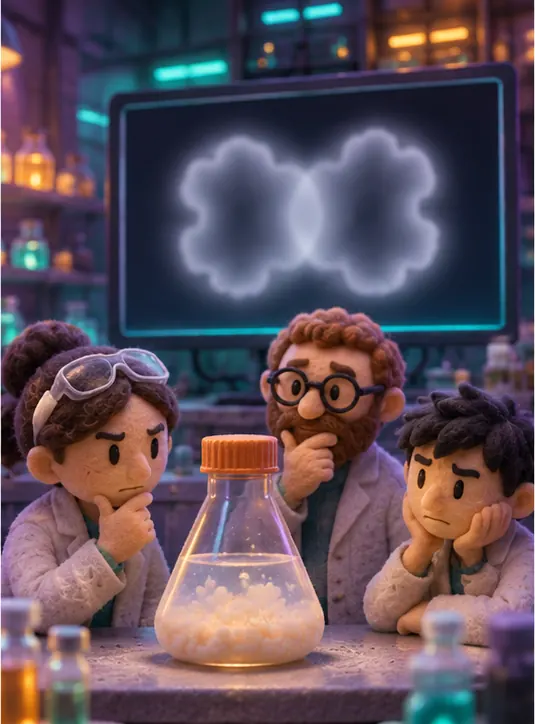
The write-up is candid about the failures. Claude's growth medium recipe contained an additive that blocked DNA uptake and cost two weeks, and it skipped a processing step and produced a map blended with its own mirror image. The team says it caught errors quickly only in areas it knew well.
Humans chose the 44 candidates. The is at bioRxiv and has had no peer review, and the analysis used hundreds of , more than many academic labs can reach. Science reports that the result deepens the mystery of what vaults do.
Anthropic's biologists used Claude to solve the first structure of a vault particle from a prokaryote
Anthropic's biology team reported the first 3D structure of a vault particle from a prokaryote, a hollow protein shell whose purpose nobody knows. It comes from a phage protein called L05, expressed in E. coli: 96 copies of one protein, about 9.5 megadaltons, enclosing about 25% more volume than the mammalian vault. Claude searched about 15 billion predicted proteins for relatives, designed the DNA, proposed a purification shortcut that cut about three days to about 90 minutes, and ran the cryo-EM processing.
The write-up is candid about the failures. Claude's growth medium recipe contained an additive that blocked DNA uptake and cost two weeks, and it skipped a processing step and produced a map blended with its own mirror image. The team says it caught errors quickly only in areas it knew well. Humans chose the 44 candidates. The preprint is at bioRxiv and has had no peer review, and the analysis used hundreds of GPUs, more than many academic labs can reach. Science reports that the result deepens the mystery of what vaults do. SourcesAB
Sources
- AAnthropic: Investigating vault particles with Claudeanthropic.com
- BAI company's research deepens mystery of vaults (Science, via The Neuron)science.org
This story ran in the Morning Brief of November 5th 2026.